Joint project launched to optimise offshore wind turbine foundations
09/12/2025
The German Federal Institute for Materials Research and Testing (BAM) has launched the OptiMP joint project together with renowned partners from industry and research. The aim of the three-year project is to extend the service life of monopiles, the supporting foundations of offshore wind turbines, while reducing the amount of material and energy used in their manufacture.Monopiles are large, cylindrical steel pipes with a diameter of up to 15 m and a length of over 100 m. They are driven vertically into the seabed and serve as foundations for offshore wind turbines. Their production requires considerable amounts of resources: a single monopile can consist of over 2000 tons of steel. The associated welding processes also require a large amount of energy. The planned service life of these structures is generally no more than 30 years, limited by corrosion and mechanical stresses in the marine environment.
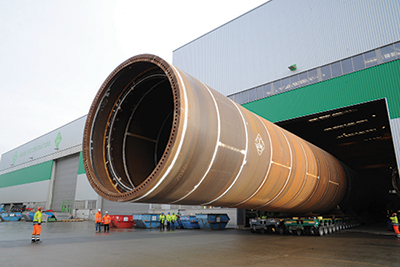 | ||
| Monopile during production at the factory Image courtesy of EEW SPC / Fotograf Andreas Duerst |
The associated consumption of resources poses a challenge to the German government’s ambitious expansion targets in the offshore wind sector, as it ties up considerable capacity in production and logistics and has a negative impact on the economic viability of wind farm projects.
This is where this project comes in: by taking a holistic view of the entire process chain, from design to manufacturing, transport, installation and operation, with the aim of identifying and leveraging new potential for lightweight construction and service life extension.
“Through targeted improvements at all stages of the process, we expect to achieve steel savings of up to 10% and a service life extension of up to 30%,” explained Marc Thiele, Project Manager and coordinator of the joint project at BAM.
One focus is on optimising the design and manufacturing of critical areas such as weld seams and free edges in order to increase the fatigue strength of the monopiles and improve their corrosion protection. In particular, post-treatment processes and non-destructive testing methods for crack detection on weld seams are being developed and investigated. In addition, realistic stress simulations will support further development of the design, as the current design rules are not specifically tailored to these large structures.
“In close cooperation with partners from industry and certification, we want to quickly transfer the project results into standardisation and thus accelerate the transfer into industrial practice,” Marc continued.
The Fraunhofer Institute for Large Structures in Production Engineering (IGP), Leibniz University Hannover (Institute of Materials Science), JBO Engineering Group GmbH, Grillo Zinc Metals GmbH and Vattenfall Europe Windkraft GmbH are participating in the joint project. Associated and project-accompanying partners are: EEW Special Pipe Constructions GmbH, Siemens Gamesa Renewable Energy, EnBW AG, Jungheinrich Norderstedt AG & Co KG, Zeiss/GOM Industrial Quality Solutions, Skyborn Renewables GmbH and DNV Renewables Certification GmbH.
The project is funded by the German Federal Ministry for Economic Affairs and Energy through Project Management Jülich as part of the 8th Energy Research Programme.
www.bam.de


