A cost-effective solution for monitoring ageing infrastructure
16/02/2026
The partial collapse of the Carola Bridge in Dresden, Germany, in September 2024 was a wake-up call for Germany’s infrastructure policy. At least 8000 highway bridges and roughly 18,000 km of railroad in Germany are now considered in need of repair, with the cost of necessary renovations currently estimated at up to €100 billion (approximately £86.8 billion). Continuous infrastructure monitoring is expensive, so it has been neglected. The Engineering of Adaptive Systems branch at the Fraunhofer Institute for Integrated Circuits IIS is working on an efficient and cost-effective solution: leveraging robust radar sensor technology originally designed for the automobile sector to monitor bridges, rail tracks and other structures.Intelligent sensors can efficiently and sustainably extend the lifespan of bridges and other civil engineering structures, ensure greater precision when planning renovation work and enhance safety. In Germany, the inspection and monitoring of civil engineering structures, especially bridges, is governed by the DIN 1076 standard. While this standard prescribes regular structural inspections, it currently contains no provisions for continuous structural monitoring, which can provide a solid database for assessing renovation requirements or estimating remaining service life. Fraunhofer IIS is a member of Deutsche Gesellschaft für Bauwerksmonitoring e.V. (the German Society for Structural Monitoring), which is calling for sensor-based monitoring to become an integral part of the standard. However, there is a problem: the market for specialised structural monitoring sensors is small, making the technology expensive.
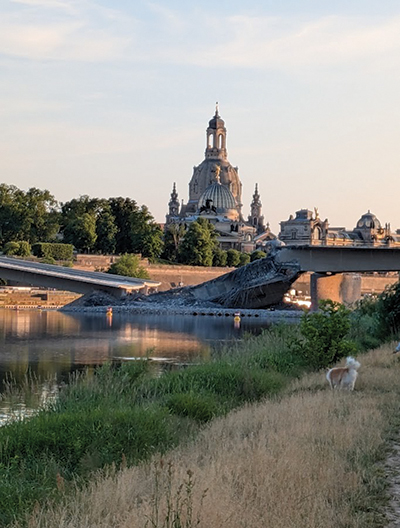 | ||
| Accidents such as the collapse of the Carola Bridge in Dresden can be better prevented by continuously monitoring engineering structures Photo courtesy of Fraunhofer IIS |
In its search for a cost-effective solution, Dresden-based Fraunhofer IIS hit upon a well-established technology that was designed to meet similar requirements. “High precision, a long service life, continuous load-bearing and temperature tolerance from −400°C to +120°C? The answer was obvious: automobile sensors,” explained Christoph Sohrmann, Group Manager at Fraunhofer IIS. “We could try microelectromechanical systems (MEMS) sensors, for example, which until now have only been used in vehicles or mobile phones but can ‘hear’ breaks in the wires of prestressed concrete bridges. We will soon be testing this principle on a real bridge in cooperation with the company MKP GmbH. However, our main focus is on radar sensors originally developed for autonomous driving.” The cost of commercially available sensors specifically designed for infrastructural monitoring is ten or even 100 times higher than that of repurposed vehicle sensor technology, since many elements, such as hardware, production standards, cybersecurity and sensor self-monitoring, can be leveraged directly from automotive applications.
Radar sensor technology from the automotive sector cannot be used as is for structural health monitoring (SHM), which aims to detect a variety of structural damage processes. Frequency-based signal processing from automotive applications does not provide the resolution necessary to identify the smallest changes in engineering structures. Fraunhofer researchers have been testing combinations of tactile sensors and non-contact radar measurements on the 45 m-long test bridge at the Dresden University of Technology’s real-world laboratory in Bautzen. The reference data obtained are being used to develop and validate sensor and monitoring concepts suitable for infrastructural monitoring applications. “Our radar sensors make it very easy to measure vibrations in building structures for purposes of condition monitoring and SHM campaigns,” said Christoph. “Our solution uses phase-based interferometric data analysis, which enables us to detect static displacements in the millimetre or even submillimetre range, as well as vibrations at frequencies up to 1000 Hz or more.”
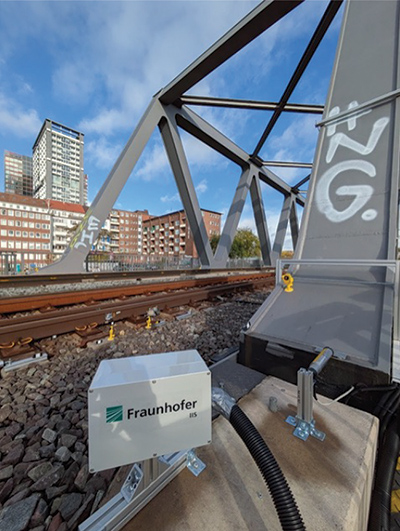 | ||
| The relatively cost-effective radar sensors developed for autonomous vehicles can, with appropriate modifications, also be used for infrastructural monitoring Photo courtesy of Fraunhofer IIS |
The measurement studies were commissioned and evaluated by the authorities responsible for the safety of the respective structures and the affiliated civil engineering offices. According to Christoph, close cross-disciplinary cooperation is essential for success. “Which data have to be collected at which frequency and precision? Are the results easy enough to read? Questions like these must be addressed to ensure that the solution developed is a perfect fit,” said Christoph. Steffen Marx, Professor of Concrete Structures at the Dresden University of Technology, has therefore been providing valuable input from a civil engineer’s perspective ever since the project was launched.
The sensors used to take the measurements, ie ground-based interferometers, are installed on or under a bridge. Dynamic measurement studies can be completed in a matter of days or weeks, whereas long-term monitoring involves the collection of data over several years. “How many sensors we can synchronise and which of them can be best optimised using suitable lenses or antennas or even reflectors on the bridges are some of the questions addressed by our follow-up project, RICARES,” explained Christoph. This project, which started in January 2026, receives funding from Sächsische Aufbaubank (SAB) and will focus on monitoring the stability of railway bridges. However, the technology can also be used for road bridges.
“Affordable sensors will enable the responsible authorities to not only monitor infrastructure in doubtful cases but also establish structural monitoring on a wider scale,” said Christoph. “They should take advantage of this opportunity, because historical data on structural stress are enormously helpful when analysing incipient damage.” In addition to RICARES, the research scientist is now seeking substantial further funding and partnerships with suitable industry partners.
www.iis.fraunhofer.de


