Detection of air-filled anomalies in Menkaure Pyramid could indicate new entrance
16/01/2026
Researchers from Cairo University and the Technical University of Munich (TUM), as part of the ScanPyramids research project, have identified two hidden air-filled anomalies in the third-largest pyramid of Giza, Egypt. The hypothesis of a possible entrance at this point on the eastern side of the Menkaure Pyramid had existed for some time. The investigations using radar, ultrasound and electrical resistivity tomography (ERT) prove the existence of two air-filled voids underneath the eastern facade, providing initial evidence to support the hypothesis.For some time now, the structure of the granite blocks on the eastern side of the more than 60 m-high Menkaure Pyramid has puzzled researchers. The stones are remarkably polished over an area around 4 m high and 6 m wide. Such smooth stones are otherwise only found at what is currently the only entrance to the pyramid, on the north side. Researcher Stijn van den Hoven hypothesised a possible additional entrance for the first time in 2019.
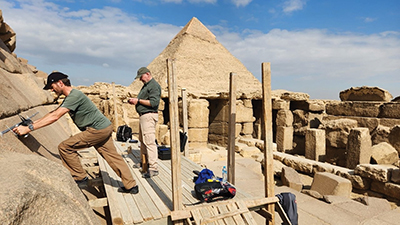 | ||
| Researchers have identified two air-filled voids in the Menkaure Pyramid Image courtesy of the ScanPyramids project |
A team from Cairo University and TUM investigated the eastern side of the Menkaure Pyramid as part of the ScanPyramids research project and detected two anomalies behind the smooth facade. Using non-destructive testing (NDT) methods with georadar, ultrasound and ERT, the researchers clearly identified two air-filled voids. This is the first time structural anomalies have been identified behind the distinctive facade on the east side.
The two air-filled anomalies are located at depths of 1.4 m and 1.13 m behind the outer facade, measuring 1 m high by 1.5 m wide and 0.9 m by 0.7 m, respectively. Such a precise determination of the air-filled voids is only possible by combining all the measurement data. The image fusion method used for this was decisive in confirming the find.
“Following the significant validation of a hidden corridor in the Pyramid of Cheops in 2023, ScanPyramids has once again succeeded in making an important finding in Giza. The testing methodology we developed allows very precise conclusions to be drawn about the nature of the pyramid’s interior without damaging the valuable structure. The hypothesis of another entrance is very plausible and our results take us a big step closer to confirming it,” said Christian Grosse, Professor of NDT at TUM.
www.mae.ed.tum.de/en


