Wall-climbing robots rise to the challenge for EDF chimney inspections
12/01/2026
Inspecting tall and complex vertical structures has always posed significant challenges for non-destructive testing (NDT) professionals, but that could be about to change thanks to robotics innovator HausBots.The company has collaborated with energy giant EDF and NDT probe manufacturer ACS-Solutions GmbH on a groundbreaking project looking at the viability of using wall-climbing robots for the inspection of large concrete infrastructure.
The project has seen a series of trials being undertaken on a large 200 m concrete chimney stack located at an EDF facility. HausBots’ climbing robotic platform, integrated with ACS’s MIRA ultrasonic tomography system, was deployed on the structure, where it successfully carried out the full range of NDT inspections, completing them in record time and with zero risk to life.
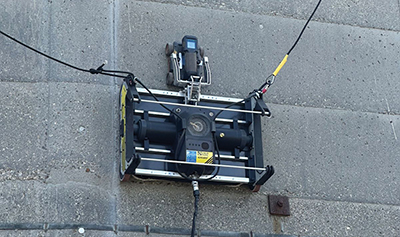 | ||
| Even on rough concrete, the adhesion system remained stable for the robotic platform to perform all assigned inspection tasks |
According to Jack Cornes, co-founder of HausBots, the results of the trial mark “a significant advancement in the application of robotics for infrastructure NDT”, demonstrating a safer, more efficient and cost-effective solution for inspecting tall structures.
By successfully integrating a high-resolution ultrasonic tomography device onto the stable, climbing crawler robot, the project exhibited a practical, safe and scalable method for inspecting tall vertical concrete assets.
Jack explained: “We are delighted to have worked with both ACS and EDF on this project, which offers yet further validation for the feasibility of robotic-assisted ultrasonic tomography for vertical structures.”
He continued: “Through this project, we have demonstrated that subsurface imaging can be automated and conducted at height without the limitations or risk of traditional access methods. From an operational perspective, it also significantly reduced inspection time and eliminated the need for working at height. In addition, it opens the door to higher-frequency inspections, enabling asset owners to adopt a more data-rich and proactive approach to structural monitoring. We believe it marks a significant advancement in the application of robotics for infrastructure
NDT.”
Inspecting tall and complex vertical structures, such as reinforced concrete chimney stacks and bridge piers, has always posed significant challenges. Traditional methods, including rope access and scaffolding, are not only logistically and financially burdensome but also come with considerable safety risks. These limitations can often result in insufficient data collection, compromising the integrity assessments of critical structures.
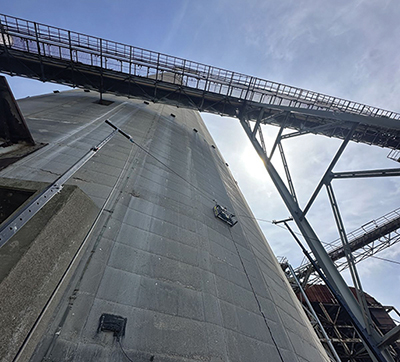 | ||
| HausBots’ climbing robotic platform, integrated with ACS’s MIRA ultrasonic tomography system, was deployed on a large 200 m concrete chimney stack located at an EDF facility |
The integration of robotics into NDT practices marks a substantial technological shift, with robotic platforms enabling the deployment of NDT probes and sensors in hard-to-reach or hazardous environments, improving safety, reducing costs and increasing inspection coverage and repeatability. It is an approach that has broad potential for application across multiple sectors and industries globally.
While aerial drones have gained traction for visual inspections, few solutions exist for direct-contact NDT on vertical concrete surfaces, especially where subsurface imaging is required.
HausBots’ proprietary Aerogrip adhesion system combines controlled airflow and suction to create low-pressure zones beneath the robot chassis, enabling strong adhesion to various vertical and inverted surfaces, including rough and porous materials such as concrete.
The field test demonstrated the ability of the robotic platform to perform all assigned inspection tasks without failure. The adhesion system remained stable throughout the climb and scan procedures, even on rough concrete. The MIRA device, mounted on the robot, acquired high-quality tomographic scans at each test location. Key performance metrics included consistent scan resolution, significant deployment time savings, cost reductions and zero personnel risk exposure for elevated positions.
Jack concluded: “The implications for the industry are clear: robotic NDT platforms can offer improved safety, reduced costs and better-quality data for asset owners. As robotic platforms evolve and sensor integrations become more modular, we expect the adoption of these systems to grow rapidly.”
www.hausbots.com


