New IAEA research project to enhance disaster management with AI-augmented non-destructive testing
02/03/2026
A new International Atomic Energy Agency (IAEA) research project will investigate how artificial intelligence (AI) can be used to strengthen non-destructive testing (NDT) techniques used in disaster response. The project aims to enable faster, safer and more reliable engineering assessments critical for disaster response and recovery. Hannah Asamoah Affum, IAEA Department of Nuclear Sciences and Applications, explains…Disasters, including earthquakes, floods, tsunamis, extreme weather events and industrial accidents, have increased in frequency and severity in recent decades, putting greater strain on critical infrastructure worldwide. The ability to rapidly and accurately assess the integrity of bridges, buildings and dams after such events is essential for protecting people, facilitating operations and guiding efficient recovery.
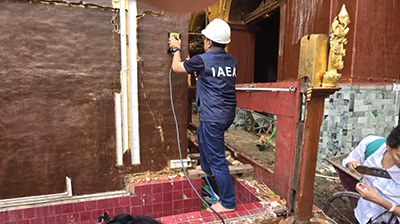 | ||
| IAEA experts assess damage to a building after a devastating 7.7 magnitude earthquake in Myanmar in March 2025 Photo courtesy of G M-Seminario/IAEA |
The IAEA’s new five-year coordinated research project (CRP) will explore how AI technologies can be integrated with advanced NDT to deliver real-time, data-driven insights. This integration promises to transform disaster management practices by enabling faster damage detection, reducing risks, accelerating interventions and ultimately safeguarding communities and assets.
NDT has long played an important role in post-disaster safety evaluations. Through regional and national technical cooperation projects, the IAEA has supported countries in building expertise in NDT for civil engineering, helping to develop national capacities for rapid infrastructure assessment following disasters.
Today, AI offers opportunities to significantly enhance the speed, accuracy and practicality of these assessments. Deep learning methods and convolutional neural networks, for example, can automate damage detection, accelerate data interpretation and ensure more consistent evaluation of complex structures.
When combined with traditional NDT methods, including ultrasonics, radiography, imaging, rebar detection and hardness testing, or applied to data from drone-based inspections, such as thermal, radiographic and tomographic imagery,
AI-augmented NDT can expand the toolkit available to emergency responders and engineers.
The CRP aims to strengthen global disaster resilience by developing and validating AI-enhanced NDT methodologies that enable rapid, accurate and practical structural integrity assessments.
The project will foster international collaboration by bringing together research institutions, laboratories, universities and specialised agencies from IAEA member countries to advance the next generation of NDT for disaster resilience.
The outcomes of this CRP are expected to benefit engineers, civil protection authorities, disaster-response teams and national institutions responsible for infrastructure safety.
Specific research objectives include:
- Investigating AI and other emerging technologies for developing advanced NDT methodologies applicable to complex disaster scenarios.
- Designing experimental studies to generate datasets for training and validating AI models used in NDT for civil engineering.
- Establishing protocols and data standards for the collection, processing and sharing of AI-enhanced NDT data to support interoperability and coordinated disaster management.
- Developing and validating AI-augmented NDT methodologies that improve the speed, accuracy and reliability of post-disaster structural assessments.
- Creating frameworks for effectively integrating AI-enhanced NDT outputs into engineering models and decision-making processes for disaster management.


