Reliable and precise detection of inclusions in aluminium melts using ultrasound
12/08/2026
The Fraunhofer Institute for Nondestructive Testing IZFP in Saarbrücken, Germany, has showcased its ‘AloX’ measurement system, winner of the Joseph von Fraunhofer Prize, which enables the rapid, continuous and precise determination of the level of non-metallic inclusions in aluminium melts. This addresses a key challenge in aluminium casting, as non-metallic inclusions have a decisive impact on the quality of the resulting components and the increasing use of secondary aluminium further exacerbates this issue.In times of scarce resources and strict climate targets, aluminium is becoming increasingly important. It can be recycled with minimal energy consumption and, with its very low weight combined with good strength, offers a unique combination of properties. This makes aluminium indispensable for many applications, such as lightweight construction. Sufficiently high material quality is crucial for the safe and sustainable use of aluminium. Molten aluminium should be as pure as possible, as foreign substances in the form of particles can later have a negative impact on component properties. These mostly non-metallic inclusions reduce mechanical properties, as they act like notches or cracks within the component. Particularly in the automotive industry or aerospace, resulting material damage can have serious consequences. Therefore, inclusions in the melt should be detected as early as possible to prevent them from remaining in the final component.
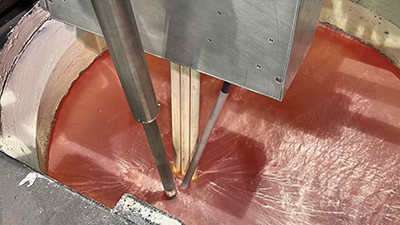 | ||
| The AloX measurement system ensures seamless measurement of melt quality in aluminium Image courtesy of Fraunhofer IZFP/Uwe Bellhäuser |
Previous approaches to detecting particles in melts were either too time-consuming, too expensive, inaccurate, non-reproducible or only feasible for experts.
With the AloX measurement system from Fraunhofer IZFP, industry now has access to a method that is fast, reliable and cost-effective. The system employs an innovative ultrasound-based approach. As AloX detects impurities in the aluminium melt during production, a high level of product quality can be ensured. This relies on the principle of ultrasonic backscattering: ultrasound is coupled into the aluminium melt and the reflected ultrasound components are detected. This allows the number of inclusions, their size and their distribution to be quantified.
AloX is highly flexible and can measure both in the channel and in the crucible. The system can also be used in difficult measurement positions, ensuring seamless monitoring of melt quality. Furthermore, its operation requires no expert knowledge. The measurement can therefore be performed by employees in the foundry.
As a next step, the researchers plan to expand the technology of the measurement system: “What works in aluminium melts could also work in other melts. For now, we are primarily focusing on low-melting-point alloys, particularly magnesium, tin and zinc, all of which have melting points below 600°C. In the long term, however, steel could also be considered as a target melt,” explained Dr Thomas Waschkies and Andrea Mroß.
www.izfp.fraunhofer.de


