More efficient quality assurance for 3D printed components in the aviation industry
10/07/2026
As part of the SONRISA project, the Federal Institute for Materials Research and Testing (BAM) in Germany is developing innovative methods to assess the quality of metal 3D printed components more quickly, reliably and cost-effectively. The goal is to make the testing of additively manufactured components in aviation more efficient, thereby enabling the broader use of such parts. Due to their optimised weight, these components also help reduce fuel consumption and emissions.Aircraft are set to become lighter in the future to save fuel and protect the climate. Additive manufacturing plays a key role in this. It enables the production of particularly complex yet lighter metal components, such as highly efficient heat exchangers. In aviation, every weight reduction counts, as aircraft remain in service for several decades.
Yet, despite its potential advantages, additive manufacturing has so far been adopted only hesitantly in the aviation industry. The reason: in no other industry are safety requirements higher. Every safety-critical component must be thoroughly inspected for defects before it is installed. However, this remains a very time- and cost-intensive process in 3D printing because the components are usually very intricate and custom-designed. Potential defects, such as tiny pores or cracks, are not visible from the outside and conventional inspection methods reach their limits here.
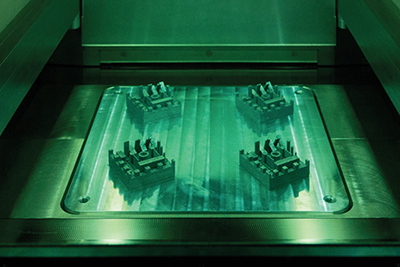 | ||
| Additive manufacturing of intricate components Image courtesy of BAM |
This is where the SONRISA collaborative project comes in. The team is developing a digital method that allows the quality of a 3D printed component to be monitored and evaluated during the manufacturing process itself. This enables early detection of potential defects and reduces the need for subsequent inspections. “We want to make the manufacturing process more transparent and determine during production whether a component meets the high standards of the aviation industry,” said Gunther Mohr, SONRISA Project Manager at BAM. “This saves time, costs and resources.”
The project combines several measurement systems that monitor the 3D printing process, specifically laser powder bed fusion. In this process, metal powder is applied layer by layer and melted using a laser. Among other things, the measurement systems detect whether the powder is applied evenly and whether the surface of the component reveals any defects.
This information is linked with high-resolution computed tomography X-ray images of the components. This allows the signals from the monitoring systems to be specifically compared with the actual properties of the component. Based on these findings, it can be determined at an early stage which areas will require particularly thorough inspection in the future. This makes quality assurance significantly more efficient.
The new methods are intended to significantly shorten inspection times, increase accuracy and make a substantial contribution to the reliable assessment of process stability and component quality for additively manufactured parts. This makes 3D printed components an increasingly attractive option for use in the aviation industry.
In addition to BAM, leading companies from the aviation and manufacturing industries, including Boeing Deutschland GmbH, Liebherr-Aerospace Lindenberg GmbH (consortium leader), MTU Aero Engines AG and Materialise GmbH, are participating in the project, along with Carl Zeiss Industrielle Messtechnik GmbH as an associated partner. Each partner contributes practical experience as well as industrial research and development expertise to the project. In addition, project progress is discussed at regular intervals with the European Union Aviation Safety Agency (EASA) to ensure that certification-related aspects are taken into account from the outset.
The project is funded by the German Federal Ministry for Economic Affairs and Energy (BMWE) as part of the LuFo VII-1 aviation research programme.
www.bam.de


