UTM students awarded full sponsorship
08/06/2026
A delegation of seven students, together with their advisor, Ts Dr Mohd Khairul Afzan Mohd Lazi from the Faculty of Civil Engineering (FKA), Universiti Teknologi Malaysia (UTM), has been fully sponsored by the Sakura Science Exchange Programme, an international initiative organised by the Japan Science and Technology Agency (JST), to travel to Kyoto, Japan.Hosted by the Graduate School of Engineering, Kyoto University, from 9-15 February 2026, the programme was conducted under the theme ‘Sensing for infrastructure management and data analysis’. The exchange brought together academic excellence and practical exposure in one of Japan’s leading research environments. As infrastructure systems worldwide face increasing environmental and loading demands, the integration of sensing technologies and data-driven analysis has become essential to ensure safety, resilience and sustainability.
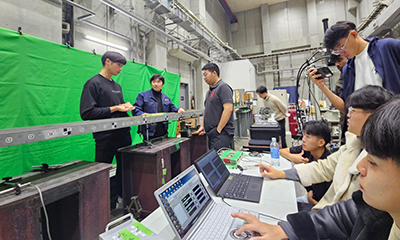 | ||
| A vibration monitoring experiment was conducted in collaboration with the team from Kyoto University |
Throughout the seven-day programme, the UTM delegation engaged in a series of academic lectures, laboratory experiments and technical visits led by Professor Kim Chul-Woo, Vice Director of the Institute of Liberal Arts & Sciences and a professor at the Disaster Prevention Research Institute, Kyoto University.
A foundational lecture on structural health monitoring introduced participants to modern sensor technologies and identification techniques used in infrastructure maintenance. This theoretical knowledge was reinforced through hands-on laboratory work at Kyoto University’s Structural Laboratory, where students installed sensors, conducted structural health monitoring experiments on bridges and collected real-time structural response data.
Beyond experimentation, participants analysed the acquired data and interpreted structural behaviour under guided supervision. The short-term project culminated in a formal presentation session, where findings were shared and discussed with Japanese professors and students. This academic exchange strengthened analytical thinking, communication skills and collaborative problem-solving abilities.
The programme also included technical visits that enriched the learning experience. A visit to the Disaster Reduction and Human Renovation Institution in Kobe, Japan, exposed participants to Japan’s advanced disaster mitigation strategies, while a technical tour of the Akashi Kaikyo Bridge offered first-hand insight into large-scale bridge engineering and long-term monitoring systems.


