Proceq assists in advancing infrastructure inspection through National Highways’ ‘Structures Moonshot’ with NDT, AI and robotics
26/03/2026
Proceq has recently shared its involvement in the Structures Moonshot programme, a groundbreaking research initiative by the UK’s National Highways aimed at transforming the management of ageing infrastructure.The project, led by AtkinsRéalis and Jacobs and supported by VSL, provided a rigorous testing ground for non-destructive testing (NDT) technologies to move the industry towards a future of self-monitoring and predictive maintenance.
The research focused on the decommissioned A14 Huntingdon Railway Viaduct (HRV), a complex structure featuring post-tensioned cantilevers and half-joints. These hidden critical components are notoriously difficult to inspect without destructive methods.
By utilising sections of the viaduct before their planned demolition, the Moonshot team called for blind trials. This allowed NDT professionals to scan for defects before the results were physically verified through hydro-demolition.
A key objective of the Moonshot programme was to identify how innovative technologies could be deployed in safer, more efficient ways. A standout example of this was the collaboration with HausBots’ wall-climbing robotics. HausBots successfully integrated several Proceq sensors, including the GP8000 ground-penetrating radar (GPR), Profometer cover meter and the Profometer PM8500 corrosion potential sensor, onto its climbing crawlers, demonstrating that high-precision NDT can be achieved on tall or inverted surfaces without the need for scaffolding or lane closures.
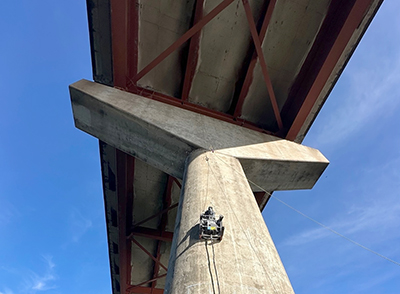 | ||
| The Moonshot programme aimed to identify how innovative technologies could be deployed in safer, more efficient ways |
The integration of Proceq’s sensors with HausBots’ robotic platforms enables a ‘zero-heights’ approach to structural health monitoring. The combination proved that robotic platforms are now fully capable of carrying advanced sensors with total stability and control, even on tall buildings under high winds.
The combination of the HausBots crawler and Proceq sensors is currently being utilised on live inspection projects within the nuclear, civil and energy sectors and even in surveying historical buildings by companies such as EDF, Sellafield, Network Rail and many other inspection providers.
The Moonshot trials showcased the effectiveness of a multi-technology approach.
In collaboration with Bridgology, Proceq GPR data was used to unlock 3D visualisations of the internal reinforcement. Bridgology further utilised this data to develop heat maps of chloride and corrosion risk, correlating their findings with the Proceq Resipod electrical resistivity data provided by the CTS Group. This technology has been effectively paired with the ultrasonic pulse-echo technology, each complementing the other in detecting voids and moisture.
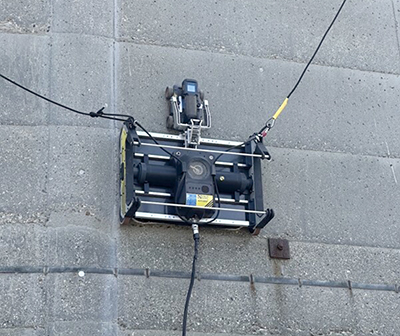 | ||
| The Proceq GP8000 GPR deployed with a HausBots robot climber |
Using the Pundit PD8050 and PI8000, Mistras and the Screening Eagle team successfully identified suspected voids within tendon ducts. This ultrasonic pulse-echo and impact-echo data is critical for assessing the risk of internal grout deficiency and subsequent tendon deterioration.
The results of these trials are contributing to a National Highways ‘Practitioners’ Toolkit’, designed to help engineers worldwide select the most effective NDT tools for specific structural challenges.
The Structures Moonshot confirms that while no single technology is a ‘silver bullet’, the integration of powerful sensors with robotics and artificial intelligence (AI) is the path forward. Proceq is proud to see its technologies being utilised by innovative partners to solve the industry’s most pressing safety challenges and is grateful to National Highways, AtkinsRéalis, Jacobs, VSL and all the participating NDT specialists.
www.screeningeagle.com


