Testia pioneers future of NDT with state-of-the-art robotised ultrasonic cobot inspection system
18/03/2026
Testia has announced a milestone that firmly establishes its position at the forefront of non-destructive testing (NDT) technology development: the successful delivery and handover of a robotised ultrasonic development and inspection system to the Airbus research and development (R&D) laboratory in September 2025.This project marks a significant achievement for Testia as it represents the first fully automated ultrasonic inspection system the company has designed and built under the Airbus Extended Make initiative.
The system is a versatile, high-precision laboratory asset capable of handling a wide range of critical inspection tasks, including complex materials. In metal parts, it is designed to identify pores and cracks within weld lines, as well as cracks in the bulk material, and in composite parts the system can detect delamination and core defects in both monolithic and sandwich composite structures.
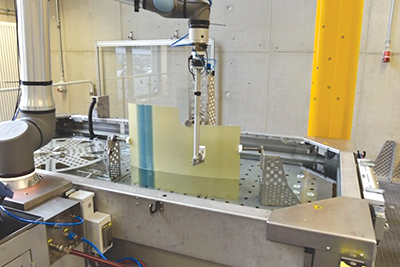 | ||
| The Testia system is capable of handling a wide range of critical inspection tasks, including complex materials |
The system offers practical flexibility by integrating multiple ultrasonic techniques. These include traditional inspections such as in-contact using a waterbox and membrane end-effector, as well as full immersion testing in a water tank (with a fork or a single head). Crucially, it also incorporates the capability for contactless inspection using a laser-excited acoustics system.
The physical design of the robotised solution is robust and optimised for laboratory testing. Its core features include a water tank measuring 1.4 m × 3 m × 1.5 m (W × L × D), equipped with a lift for part immersion and a turntable for precise inspection of cylindrical parts. A key component is the collaborative robot arm, which is mounted on a mobile base and can be fixed to one of three positions around the tank to ensure optimal reachability.
Innovation extends to the way inspections are planned and executed. The system includes a hand-held 3D scanner to generate accurate models of parts, which are then used for offline robot path planning for raster paths on complex parts. For simpler shapes, such as flat and simple curved parts, online programming software for the cobot, specific for ultrasonic testing (UT), is included.
The system is also designed for maximum adaptability through its specialised end-effectors, including those for single-side inspection, local immersion and through-transmission. It is compatible with a range of UT devices, such as Smart UE1 and Smart U32. The successful handover of the system marks a proud moment for Testia, reaffirming its capability to deliver complex, high-technology solutions that meet the demanding requirements of global aerospace leaders such as Airbus. This powerful robotised solution is set to accelerate the development of future NDT standards, ensuring the highest levels of safety and quality in aerospace manufacturing and beyond for years to come.
www.testia.com


