Triple-lens AI depth sensor
25/03/2026
Kyocera has announced the development of a triple-lens, artificial intelligence (AI)-powered high-resolution depth sensor that has been designed with the aim of delivering much greater accuracy in close-range imaging and object recognition.The new system combines three lenses with proprietary AI to detect semi-transparent, reflective and ultra-fine linear objects that have traditionally posed challenges for both human vision and conventional stereo cameras. According to Kyocera, the sensor can measure objects as small as 0.3 mm, which is three times more precise than previous models, which were limited to 1 mm.
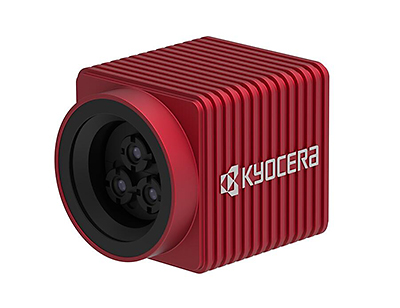 | ||
| The triple-lens AI-based high-resolution depth sensor |
This advancement is expected to benefit a range of industries, including manufacturing inspection, surgical robotics and agricultural automation. By improving depth perception and reducing blind spots, the technology aims to streamline processes that require high precision, such as identifying thin wires, reflective metals and translucent plastics.
The triple-lens configuration captures three sets of parallax data, left-centre, centre-right and left-right, from a distance of 10 cm.
This multi-angle approach virtually eliminates mismatches and enhances reliability, particularly for objects with repetitive patterns or partially obscured surfaces.
According to Kyocera, the system can accurately measure the position and size of irregularly shaped components, ultra-fine wires and other challenging materials.
The innovation builds on Kyocera’s 2024 release of a dual-lens AI depth sensor, which achieved 100 µm resolution at a 10 cm range.
Whilst the earlier model improved detection of reflective and semi-transparent objects, it struggled with items lacking distinct surface features or those partially hidden from view. The new triple-lens design addresses these limitations by providing additional viewpoints and more robust data integration.
Potential applications include:
- Electronics and textiles: enhanced inspection of circuit boards and patterned surfaces, reducing errors caused by mismatched depth readings.
- Medical robotics: precise identification of thin surgical instruments such as needles and sutures, even when partially obscured.
- Agriculture: improved recognition of crops in complex environments where leaves and fruits overlap.
Kyocera’s latest development underscores the growing role of advanced vision systems as a substitute for human eyesight in industrial and robotic applications. The company has not yet disclosed a commercial release date for the new sensor.


