Pasted signatures: Test Inspect Group makes NDT procedures checkable
11/11/2026
A written procedure is only as good as the Level 3 who stands behind it, which is exactly why some are forged. Test Inspect Group has started putting a scannable verification code on every procedure its Level 3s write, review or approve, so anyone holding a copy can check it in about a minute.Ask any experienced Level 3 and most will have a story. A procedure turns up on a site, in a tender pack or in a supplier’s quality file carrying their name, their PCN number and their signature, yet they have never seen it before. Nobody needs to forge the technical content. A real signature and certificate number are lifted from one document and pasted onto another and to an auditor, a main contractor or an end-client the result looks exactly like the real thing.
Until now, the only reliable way to check has been to find the Level 3 and ask. That rarely happens and the consequences can be serious. The procedure is the instruction the technician follows on the day: it sets out the technique, the sensitivity, the extent of testing and the acceptance criteria. If it was never properly reviewed, the inspection carried out to it cannot be relied on, no matter how well the technician did their job.
“Forged procedures with a Level 3’s signature pasted on are more common than people think,” said Lee Grears, PCN Level 3 at Test Inspect Group. “A signature on its own proves nothing. Now anyone holding one of our procedures can check it is real, without having to take our word for it.”
 | ||
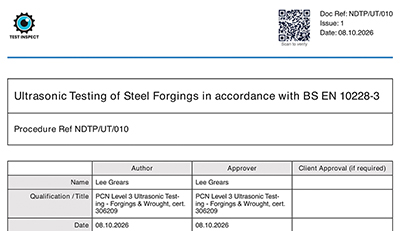
| The header of a Test Inspect procedure, with the verification QR code beside the document reference and issue |
Since October 2026, when one of the group’s Level 3s approves a procedure, its document system gives that issue a unique verification code. A QR code is printed in the header of every page, next to the document reference, and the code itself appears in the footer. It works the same for a PDF on screen and a printed copy on site.
Anyone holding a copy scans the QR code, or types the code in at testinspect.com/verify-procedure. They then enter the document reference and issue number printed on their copy; these must match what was issued under that code, so a genuine code copied onto a different document fails at the first step. A one-time code is then sent to the checker’s email address, which stops procedure details being harvested by guessing codes and means every check is traceable.
The result shows what was actually issued, drawn from the group’s live records rather than from the document in the checker’s hand: the title, document reference and issue number, the issue date, the author and approver with their qualifications exactly as they appear on their certificates and the number of pages. If any of it does not match the copy, it is not genuine.
This process proves three things: authenticity, as the code, reference and issue must all match a record the group created when the procedure was approved; integrity, as the page count and a digital fingerprint of every PDF produced are recorded (the checker shows the issued page count, so pages added or removed show up straight away and a PDF sent back to the group can be confirmed byte for byte against the file it produced); and status, as the checker also shows whether that issue is still the one in force, because the record is live. When a later issue is approved, earlier copies show as superseded. A draft sent out for comment shows as a draft, not an approved procedure, however official it looks. A withdrawn procedure shows as withdrawn on every copy in circulation. Keeping superseded procedures out of use on site has always relied on document control at the user’s end; this gives the person on site a way to check for themselves.
 | ||
| A procedure review at Test Inspect Group |
The checker names the person who wrote the procedure and the person who approved it, with their qualification in full. For the group’s own ultrasonic procedure for steel forgings, NDTP/UT/010, that reads ‘PCN Level 3 Ultrasonic Testing – Forgings and Wrought’ with the certificate number, a specific qualification held by a named person, which anyone can then confirm against the PCN register.
The same check is applied to procedures the group’s Level 3s prepare for clients on the client’s own template and under the client’s own reference, so a client’s auditors and main contractors can confirm those procedures independently too.
The group is clear about the limits. Procedures issued before October 2026 do not carry a code; anyone holding one can email the reference and issue number to the group to have it confirmed. Also, no code can stop someone typing up a fake that carries no QR code at all. “That is why the simplest rule is the best one,” said Lee. “If a procedure claims a Level 3’s approval, ask for a copy you can check.”
Online checks are already familiar for personnel certification: anyone can look up a PCN holder. Procedures, which arguably matter just as much on the day, have lagged behind. The approach needs nothing more from the person checking than a phone and it could be applied by any organisation issuing Level 3-approved documents. Test Inspect Group says it would welcome a conversation with other Level 3s and employers about making checkable procedures the norm rather than the exception.
More on how the check works is available at: testinspect.com/verified-procedures
testinspect.com


