Real-time non-destructive testing of film packaging seals: early detection of the smallest defects
14/10/2026
Every year, billions of products are sealed in film packaging. This packaging must be reliably leakproof, especially in regulated sectors such as in the medical and food industries. In the OCTinline project, researchers at the Fraunhofer Institute for Ceramic Technologies and Systems IKTS have developed an innovative testing system. Optical coherence tomography (OCT) can be used to non-destructively detect defects in seals in real time during the packaging process, with a resolution in the micrometre range.“Optical coherence tomography is an imaging method that uses infrared light,” explained Conner Phillips, a research scientist in the Characterization Technologies Group at Fraunhofer IKTS. “This method was originally developed for ophthalmology, but it can non-destructively generate three-dimensional images of the subsurface structure of a wide variety of materials and detect the presence of irregularities or defects.” The system works by sending near-infrared light into the material and detecting the reflected signals. This data produces high-resolution three-dimensional images of the internal structure. Material defects, air pockets or inadequately sealed areas are rendered visible without damaging the packaging or the product.
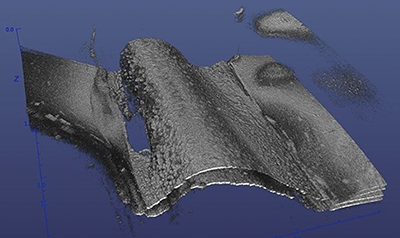 | ||
| 3D rendering of a defective seal Photo courtesy of Fraunhofer IKTS |
In the publicly funded OCTinline project, the IKTS researchers integrated the OCT technology directly in the sealing process in the packaging machine of an industrial partner. The system continuously and non-destructively tests the quality of the packaging seal in real time as the process is running at production rates of up to 25 m per minute. “We can detect and visualise various pores in the seal down to a size of 8 μm,” said Ralf Schallert, Characterization Technologies Group Manager at Fraunhofer IKTS.
The actual challenge lies in combining this high resolution with a high production rate. The smaller the defects are, the more data has to be collected and analysed. Integrating the system into the industrial process also posed challenges for the project team. Even the slightest vibration of the film can affect the measurement. “We had to achieve a balance between depth of field, exposure time and film movement,” said Conner.
New requirements for sustainable packaging make reliable seal integrity testing even more important. More manufacturers are turning to recyclable mono-material films. These are easier to recycle than multi-layer composite materials. “Mono-material films are very attractive from an environmental perspective, but they are unfortunately more prone to seal defects,” said Ralf. “This increases the need for continuous monitoring.”
Real-time testing has multiple benefits for manufacturers. Faster defect detection reduces scrap and material consumption. In addition to detecting actual defects, the system also provides information on the condition of the machinery and tooling.
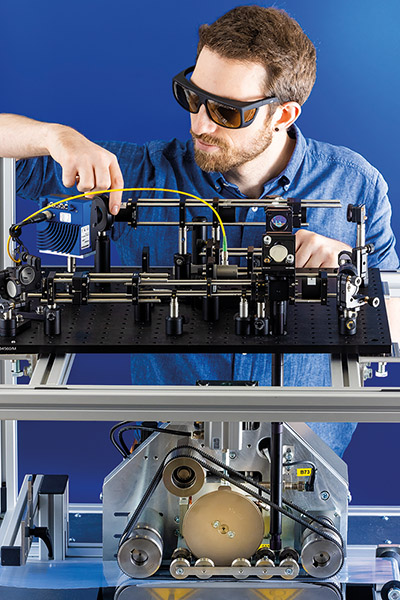 | ||
| The innovative test system based on OCT from Fraunhofer IKTS enables real-time non-destructive detection of defects in seal seams at high resolution, even during the packaging process Photo courtesy of Fraunhofer IKTS |
“Many defects arise because the pressure and temperature are not optimised for the material or because the tools are wearing down over time,” explained Ralf. “The OCT data enables us to visualise changes like this and to detect them at an early stage, such as when a tool change is necessary.”
A demonstration system has been used by the project partner Kallfass Verpackungsmaschinen GmbH in Nürtingen since July 2026, where it is also presented to potential customers.
“The packaging industry is only one of many potential areas where this technology can be used,” added Ralf. The systems can be individually adapted to different materials and requirements. The technology can thus be used for a wide range of industrial applications.
It is suitable for transparent and semitransparent materials and for many tasks in industrial quality assurance. For example, functional coatings, ceramic components or parts produced by additive manufacturing can be tested in addition to packaging. “OCT can play an important role wherever thin layers, internal structures or the smallest defects have to be reliably detected. Potential applications range from medical technology to functional surfaces to industrial 3D printing,” concluded Ralf.
www.ikts.fraunhofer.de/en.html


