Thermal imaging of a Southwest China photovoltaic base solves major O&M challenges
24/09/2026
China is investing in photovoltaic (PV) installations at a rapid pace and becoming a core market, holding more than 40% of global capacity. While the future of PV power generation is promising, the industry faces significant challenges: intermittency, output fluctuations, poor accuracy, high operational risks and the inefficiencies that come with traditional operations and maintenance (O&M). All of these barriers risk hindering industry development.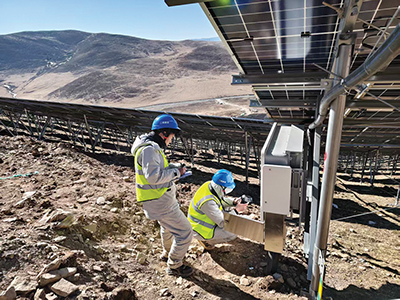 | ||
| China is investing heavily in photovoltaic installations, with over 40% of global solar capacity |
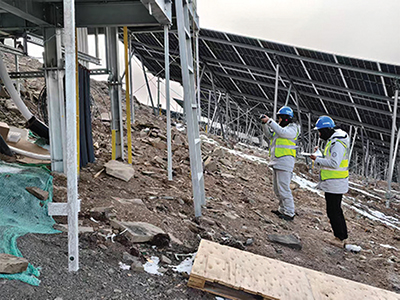 | ||
| A hydro-wind-solar base in southwest China is employing thermal imaging to address major O&M issues |
Many companies are turning to infrared imaging technology as a tool to help them overcome these challenges. Thermal imaging cameras such as the Flir T540 are invaluable for predictive maintenance at large-scale power generation facilities. In fact, an 80 GW integrated hydro-wind-solar base in southwest China has employed the T540 with a dual field-of-view (FOV) lens to successfully address major O&M issues.
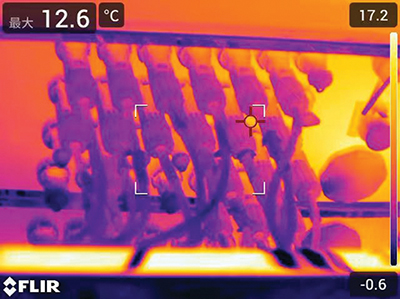 | ||
| Overheating points on heat sinks and terminals are all detectable through thermal imaging, preventing equipment burnout and improving conversion efficiency by 3%–5% |
The Flir T540 professional infrared thermal camera, paired with the FlexView dual field-of-view lens, is a powerful tool for PV O&M. Without manual lens replacement, it enables instant switching between a 24° standard FOV and a 14° telephoto FOV, ensuring efficient and precise fault localisation.
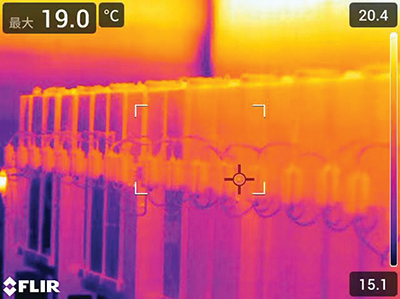 | ||
| The T540 detects localised overheating or abnormal temperature rise during battery bank inspection, preventing performance degradation or damage |
Based on on-site conditions and with thermal imaging in their toolkit, the O&M team developed a ‘proactive prevention’ strategy that balances inspection efficiency and accuracy while significantly reducing operations and maintenance costs and time.
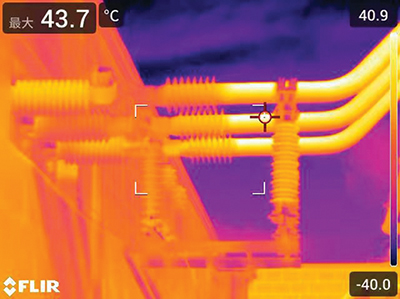 | ||
| During insulated busbar inspection, poor contact or insulation ageing can be detected early on the T540, preventing short circuits or fire hazards |
Issues such as shading, damage or diode failure all appear as hotspot areas with >5°C temperature difference through a thermal imaging camera. The Flir T540 accurately identifies these zones, enabling repairs within 24 hours and preventing 20% to 50% power loss.
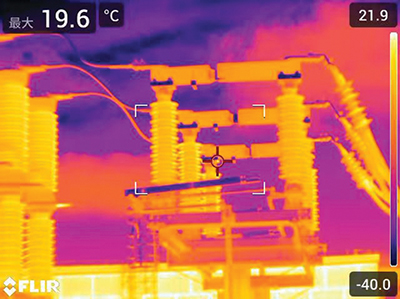 | ||
| Abnormal temperature rises in SVG power modules, reactors and cable joints can be caught early, preventing degradation and downtime |
Microcracks or cold-solder joints create linear or mesh-like low-temperature patterns (~1°C difference). The T540 captures these subtle defects, enabling repairs within 72 hours and extending module lifespan.
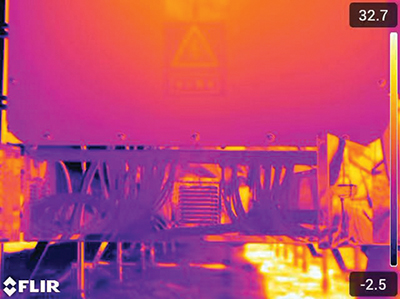 | ||
| With the dual field-of-view lens, the T540 enables users to detect short circuits early while operating the camera from a safe distance |
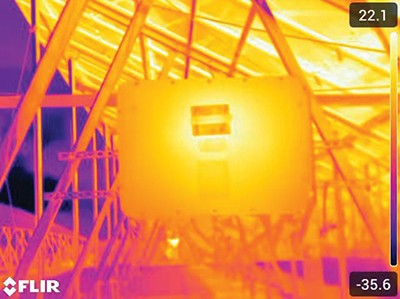 | ||
| Temperature anomalies caused by deformation or loose components are revealed with thermal imaging, enabling timely adjustment to reduce power loss |
Potential-induced degradation (PID) causes stripe-shaped high-temperature zones along module edges. The T540 can clearly reveal these patterns, allowing resolution within seven days to prevent further
degradation.
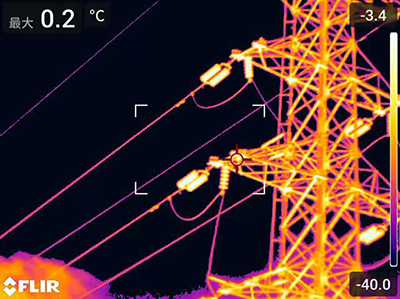 | ||
| Hotspots caused by poor contact or overload on transmission lines can be easily identified for repair |
From this real-world case, it is shown that the Flir T540 professional infrared thermal camera, combined with the FlexView dual field-of-view lens, is reshaping the PV operation and maintenance system. By enhancing power generation efficiency, reducing O&M costs and strengthening safety risk control, the T540 drives the industry towards a ‘proactive prevention’ model through technological integration and scenario expansion, ultimately enabling high-quality development.
www.flir.com


