Structures Moonshot call for ideas
27/04/2026
Through the National Highways Structures Moonshot project, a wide range of non-destructive testing (NDT) techniques have been trialled, both established and emerging, to evaluate their effectiveness in assessing the condition of hidden critical bridge elements, including post-tensioning systems and half-joint details.
As the project continues, expressions of interest and innovative ideas are now being invited to support a live forensic investigation into crack propagation within a reinforced concrete half-joint bridge element. This work will use a full-scale sample taken from the previously decommissioned A14 Huntingdon Railway Viaduct.
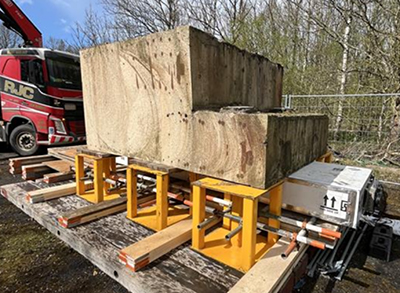 | ||
| The Structures Moonshot project is calling for ideas for identifying three-dimensional crack propagation in a half-joint bridge sample |
A key uncertainty for ageing half-joint bridges is understanding how cracks initiate and propagate through re-entrant corners, particularly through the depth of the section.
While surface observations and conventional inspections provide partial insight, there remains a clear gap in the company's ability to identify, characterise and validate internal cracking and to do so in a robust and repeatable manner to assess cracking across the full width of a bridge.
As part of the Structures Moonshot programme, this project presents a rare opportunity to trial and validate inspection technologies against ground truth, as the bridge sample will ultimately be physically dissected during the research programme.
Novel or emerging techniques that can help detect, image or characterise internal concrete cracking at re-entrant corners are being sought, including (but not limited to):
- Techniques capable of identifying crack presence, orientation, depth or continuity.
- Approaches suitable for near-surface or full-depth assessment, particularly from the soffit.
- Methods that can operate on a real, reinforced concrete structure, rather than laboratory specimens.
- Technologies that would benefit from validation through subsequent physical demolition.
It is important to note that this call is not limited to traditional NDT methods. The project is equally interested in cross-disciplinary approaches, including (but not limited to) civil engineering, materials science, geophysics, robotics, sensing technologies or data-driven inspection methods.
The focus is on identifying cracking, not on deterioration of reinforcement. Technologies that only infer cracking indirectly through reinforcement deterioration may be of limited value for this specific trial.
Participation offers:
- The opportunity to take part in a funded trial (for selected technologies).
- Access to a full-scale half-joint sample removed from a live highway structure.
- A defined programme enabling trialling, learning and validation.
- Direct comparison of inspection outputs with physical evidence once the sample is dismantled.
- A collaborative environment involving client, consultant and specialist partners.
- Involvement in a global, industry-leading research programme.
The aim of this call is to identify a small number of promising techniques for focused and proportionate trials on the Huntingdon sample.
Successful approaches may inform future inspection strategies for half-joint bridges more widely. At this stage, concepts and expressions of interest are sought, not fully developed proposals.
If you have a technology, method or idea that could help address this challenge, a short response outlining the principle of the technique, the type of cracking information it could provide and any relevant previous applications or trials are welcomed.
Please contact: moonshot.comms@atkinsrealis.com to discuss further.
Closing date: 17 May 2026.


