Module-level sensor system detects faults in large photovoltaic power plants early
03/06/2026
Present systems do not monitor large photovoltaic (PV) plants on the module level. Yet, that is exactly where faults occur, which affect the connection of several solar modules in series, that is, the complete string. Together with partners, research scientists at the Fraunhofer Institute for Factory Operation and Automation IFF are developing a sensor system that provides a detailed view down to the module level, thus detecting all types of anomaly, soiling and defect early.Large photovoltaic power plants often comprise tens of thousands of modules and components. Whenever individual solar modules malfunction, intact bypass diodes can contain a strong power loss in the string. If the bypass diodes are defective, the overall efficiency of the solar module string drops significantly, resulting in economic losses, diminished output and reduced availability. The problem is that large PV plants are usually only monitored on the string or inverter level, keeping the condition of individual modules hidden.
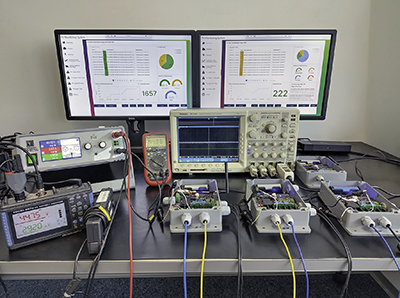 | ||
| Sensor systems developed in the ZeroDefect4PV project Photo courtesy of Fraunhofer IFF |
In the ZeroDefect4PV project, research scientists at Fraunhofer IFF, together with their partners BEIA Consult International and INELSO Innovative Electrical Solutions, are developing a sensor system that will enable module-level monitoring and predictive maintenance of large PV power plants in order to prevent undetected defects and to detect anomalies early.
“Every kilowatt hour from renewables that is not injected increases the need for fossil balancing power and contravenes climate mitigation targets. Photovoltaics’ growing systemic relevance requires greater transparency, forecasting quality and reliability. We will achieve this in the future with our solution, which combines a high-resolution, module-level sensor system with artificial intelligence (AI) diagnostic, forecasting and anomaly detection modes and a modular platform for the collection, synchronisation, preprocessing and storage of all data,” said Hannes Peter Wasser, Research Scientist at Fraunhofer IFF.
 | ||
| The control centre at the Elbfabrik Photo courtesy of Andreas Lander |
Established monitoring methods collect the data an inverter supplies over all strings. Although this approach is suited for overall performance monitoring, it does not detect module-level faults. Measurements taken at the inverter miss or often only detect certain fault types with a delay, once they are significantly affecting the energy efficiency. Drones and stationary cameras are also subject to limitations that only permit periodic monitoring. They can only be used contingent upon the weather, have to cover an entire PV farm or are only able to identify visible faults. Optical methods, such as infrared thermography, detect hotspots and visible cell cracks. Degradation, delamination, bad back foils and system errors, such as ground faults, are consequently only detected to a limited extent or not at all. Faulty electrical connections frequently go undetected.
The project is instead pursuing an approach that uses continuous and highly granular module-level monitoring. The sensors developed by INELSO Innovative Electrical Solutions in the ZeroDefect4PV project, on the other hand, deliver disparate, high-resolution measurement data for every single solar module, updated in keeping with the particular scan rate: sensors installed on the backs of photovoltaic modules measure individual solar panels’ direct voltage and direct current and the module temperature as an indicator of thermal load and faults. Insolation is also factored in. Rather than being measured directly by the data collection units (DCUs), it is measured by a separate weather station. Its data enter into the AI models together with the DCU values.
Prototype sensors and data collection units communicate over a mesh sensor network organised as a master-slave architecture. They use the energy-saving long-range wide-area network (LoRaWAN) wireless protocol to send the data over the sensor network with the ESP-NOW communication protocol to higher-level gateways that forward the data to a data platform in a central control centre. The data are synchronised, stored securely and processed and interpreted using advanced analytics and AI models. Fraunhofer IFF has a control centre for the development and simulation of monitoring and control algorithms for power grids, which is located at the Elbfabrik, Fraunhofer IFF’s research factory.
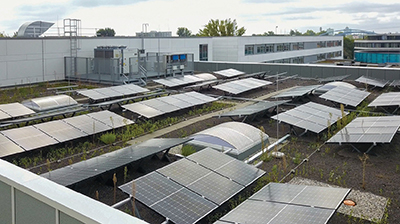 | ||
| PV system on the roof of the Elbfabrik, Fraunhofer IFF’s research factory Photo courtesy of Fraunhofer IFF/Anne Bornkessel |
Dr Christoph Wenge, another Research Scientist at Fraunhofer IFF, explained: “The widest array of faults can occur in the solar panel string, not just at the modules themselves but also in the bypass diodes, in the wiring or mounting systems. Unlike measurements taken at the inverter, our system classifies faults. It detects where they are occurring. AI models, trained with faults beforehand, analyse patterns, identify deviations from normal performance, identify anomalies and their impacts, for instance whether string A is supplying less output than string B.
“Implemented assistance functions displayed on monitors in the control centre provide control centre staff with recommended actions, for instance cleaning or replacement of a module. Faults include, for example, thermal abnormalities such as hotspots, mechanical damage such as cell cracks or delamination, electrical defects such as bypass diode faults, shading by objects or vegetation, soiling and snow coverage, module mismatching and unusual degradation and power losses.”
Tests are currently being run on the pilot system at Fraunhofer IFF. The research scientists are using minor changes and characteristics in the current and voltage curve to test whether the AI models identify the type of fault. Master and slave sensors have already been laboratory tested for sensing accuracy, stability and reliability of communication. The sensors were connected to the ICT infrastructure at Fraunhofer IFF. Other tests at Fraunhofer IFF involve targeted shading of modules by leaves and interpretation of thermal images.
In addition, tests are scheduled at INELSO Innovative Electrical Solutions, which will focus on hardware validation in a PV field in Türkiye. BEIA Consult International is testing Fraunhofer IFF’s AI models in Bucharest using SolarEdge inverters’ data on energy consumption and energy production.
“With the pilot installations, we are validating our system under real-world conditions so that we can optimise hardware, communication and data models iteratively and assess the scalability for large PV farms,” said Dr Wenge.
The ZeroDefect4PV project: ‘Upgraded module-level monitoring and predictive maintenance for optimized solar plant efficiency’, ran from February 2024 to April 2026 and was funded by the Federal Ministry for Economic Affairs and Climate Action (BMWK) as part of the ERA-Net Smart Energy Systems funding initiative.
www.iff.fraunhofer.de


