Listening to the ocean without a crew: three Canadian companies take aim at one of marine robotics' hardest problems
27/05/2026
Beneath the surface of Canada’s coastal waters lies a world of activity that no camera and no radar can see: endangered killer whales navigating shipping lanes, vessels at anchor whose engine noise reshapes marine ecosystems, undersea cables carrying the data backbone of the global economy and, increasingly, foreign assets that few nations have the means to detect. Listening to that world, continuously, at scale and without putting crews at sea for months at a time, is one the most consequential capabilities the ocean technology industry is racing to build. It is also one of the hardest.
Three Canadian ocean technology companies: Shift Coastal Technologies, Sensor Technology Ltd and Reach Systems, have just taken a significant step towards closing that gap. Through Canada’s Ocean Supercluster Port Environmental Monitoring System (PEMS) project, the three companies recently completed an integrated field trial bringing together a Canadian-made uncrewed surface vessel, a precision towed acoustic array and a powered controlled-deployment winch, the full chain required to send a robotic vessel out alone, listen beneath the waves and bring the data home.
The trial, conducted in British Columbia coastal waters, is one of the first end-to-end demonstrations in Canada of a fully integrated uncrewed acoustic monitoring system designed for independent operation.
Acoustic monitoring offers, for many marine missions, the only type of sensing that works: light does not penetrate the deep ocean; radar stops at the surface; optical cameras struggle in turbid coastal waters. Hydrophones, by contrast, can reveal a southern resident killer whale calling kilometres away, the engine signature of a freighter idling at anchor, the acoustic fingerprint of a submarine or the subtle change in a busy port’s soundscape that signals an environmental shift.
That data underpins decisions that matter: marine mammal protection, port and harbour security, anti-submarine warfare research, protection of critical undersea infrastructure and port environmental monitoring. Within the PEMS project specifically, acoustic data is being explored as a way to understand the engine state of vessels at anchor and the effect those vessels have on the surrounding marine environment, where ship noise is now recognised as a leading stressor on whale populations and coastal ecosystems alike.
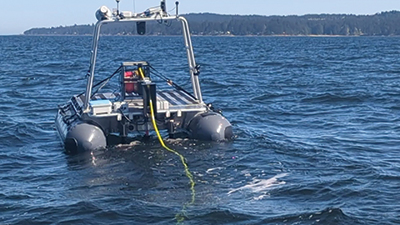 | ||
| Reach Systems’ powered sheave winch on an unmanned surface vessel |
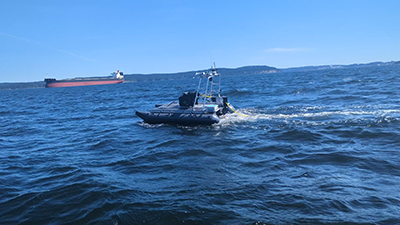 | ||
| Shift Coastal Technologies, Sensor Technology Ltd and Reach Systems have integrated a Canadian-built uncrewed surface vessel, towed acoustic array and powered deployment winch in a first field trial under Canada's Ocean Supercluster Port Environmental Monitoring System (PEMS) project |
Until recently, gathering this data has been crewed-vessel work and expensive, logistically demanding, weather-limited and ultimately bound by the endurance of the people on board. Uncrewed surface vessels (USVs) change the equation entirely. A USV can stay on station longer, cost less to operate, take on conditions that would be unsafe for a crew and scale up to fleets of platforms collecting acoustic data across thousands of kilometres of Canadian coastline. Unfortunately, getting an uncrewed platform into the water is the easy part. Carrying a sensor and deploying a sensor are not the same problem. Towed acoustic arrays are long, sensitive and unforgiving. They must be paid out at the right speed, the right tension and the right depth, then recovered with equal care. On a crewed ship, that work is carried out by experienced deck crews. On an uncrewed platform, no one is there.
The result, today, is that even capable USVs typically require a tender vessel and a human crew to handle deployment, meaning the ‘uncrewed’ mission begins only after a crewed mission has set it up. This dependency undercuts much of the cost, safety and endurance advantage uncrewed systems were built to deliver. To unlock the full promise of uncrewed acoustic monitoring, the host platform must leave the dock with its array already aboard, transit to the operating area independently and deploy and recover the sensor under its own control.
That, in turn, requires solving three problems at once: a USV rugged enough to carry the payload, an acoustic array engineered for compact uncrewed platforms and a deployment system precise enough to handle a sensitive towline without human hands on the deck. Each is hard on its own. Integrating them is harder still.
That is why the PEMS project exists. And it is why three Canadian companies, each a recognised leader in its discipline, chose to tackle it together.
Shift Coastal Technologies, based in Nanaimo, develops and operates Canadian-made uncrewed systems for marine situational awareness and threat detection. The company’s OceanSled Explorer is designed for maritime tasking, modular payloads and rugged operations in the littoral domain, exactly the environment where uncrewed acoustic monitoring is most needed and most difficult to execute.
“USVs are changing how teams approach coastal monitoring, marine situational awareness and data collection,” said James Spencer, CEO, Shift Coastal Technologies. “But real-world mission capability depends on more than getting a platform on the water. Payloads need to be integrated, deployed and operated in a way that supports the full mission. This trial was an opportunity to bring those pieces together in the field.”
Sensor Technology’s COMPASS thin line towed array brings the subsurface sensing layer that makes uncrewed acoustic missions actionable. Designed for crewed and uncrewed platforms operating in demanding environments, COMPASS delivers a low-drag profile, low power draw, small bend radius and configurable hydrophone spacing, purpose-built for compact vessels where size, weight and power constraints are real.
“Platforms get you to the water. Payloads tell you what is happening beneath it. Acoustic arrays are what turn an uncrewed mission into a decision-making capability; they surface the subsurface picture that no other sensor can provide. COMPASS was designed for exactly this: compact, low-drag and built to deliver actionable data in real operating conditions. This trial is about proving the full chain works together,” said Niru Somayajula, CEO, Sensor Technology Ltd.
Closing the loop is the piece that has historically been the limiting factor in uncrewed acoustic missions: controlled deployment from a platform with no one aboard. Reach Systems’ CROC-based winch with powered sheave is engineered to do what a deck crew once did: pay out the array under load, manage tension and angle through the powered sheave and recover the sensor without manual intervention or tender-vessel support. Reach is among a small group of companies anywhere in the world building handling systems purpose-designed for the uncrewed era and; customers across defence, scientific and commercial subsea operations rely on Reach’s cable handling and deployment technology in environments where there is no room for error.
For Reach, the trial was an opportunity to validate, in real ocean conditions, how the winch and powered sheave can underpin a category of mission that until recently was not practical at all: handing the deployment job to the platform itself.
“Field trials are where you learn what actually works,” said Colin Dobell, CEO, Reach Systems. “Going in, we knew controlled deployment from an uncrewed platform is one of the highest-value, hardest-to-solve problems in this domain and that no one solves it without iterating in real conditions. Shift brought the platform, Sensor Technology brought the acoustic monitoring capability and Reach brought the controlled deployment layer. The first trial gave us exactly what we needed: a clearer picture of what to refine, and a faster path towards making the full system work reliably.”
Unfortunately, and predictably for any genuinely difficult engineering problem, the integrated system did not work flawlessly on the first attempt. Thankfully, this is precisely what a field trial is for.
Bringing the USV, the acoustic array and the powered sheave into the same operating environment surfaced engineering lessons that no amount of dry-land testing would have produced. The deployment sequence highlighted where the interfaces between platform, payload and handling system need further refinement to perform reliably in real ocean conditions, from towline behaviour under load to the choreography between the USV’s motion and the sheave’s powered handling.
The teams are treating those findings as the deliverable, not the setback. The focus now is on refining the deployment interface, improving towline handling and validating those changes through a continued testing programme planned in the coming months.
That iterative, field-driven approach is, inevitably, how hard problems in marine technology get solved. The promise of uncrewed acoustic monitoring, quieter oceans for marine mammals, safer ports for crews and communities and persistent awareness of what moves beneath Canadian waters depends on getting the unglamorous middle layer right.
The accompanying sea trial footage (youtu.be/vp1WR9ZF9HU) shows the integrated system operating on the water during early testing, offering a practical look at the real-world conditions behind USV-based acoustic monitoring and the engineering work involved in moving from concept to reliable field deployment.
Canada has the longest coastline in the world, an ocean economy measured in the tens of billions of dollars and a marine environment under sustained pressure from climate change, shipping traffic and geopolitical contest. If only there were more data, collected continuously, at lower cost and without putting crews in harm’s way, many of the decisions that shape this environment could be made better, faster and with greater confidence.
Building the technology to gather such data is not just about a single product. It is a chain, platform, payload and handling, and a chain is only as strong as its weakest link. The PEMS field trial is a meaningful step towards making every link in that chain Canadian, capable and ready for the missions ahead.
reach-systems.com


