How robot dogs are helping to clean up Sellafield
23/04/2026
Innovation remains central to the UK’s nuclear mission and Sellafield Ltd is now using quadrupedal (four-legged) robots to accelerate decommissioning, improving safety and reducing human exposure to hazardous environments.Sellafield is said to be one of the most complex nuclear sites in the world and parts of the site are hazardous and can be difficult or unsafe to access.
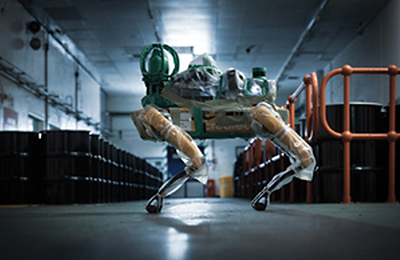 | ||
| Innovation has always been an important part of nuclear delivery in the UK and the four-legged robots are helping to speed up decommissioning, improve safety and reduce human exposure to hazards |
The decommissioning work increasingly depends on high- quality inspections. These ensure accurate data collection, enabling timely decision-making. At the same time, the need for workers to enter radiological or industrially risky areas must be reduced. Manual inspections can expose people to unnecessary hazards. This is especially the case in active areas, confined spaces or locations with restricted access.
To address these challenges, Sellafield is finding advanced solutions. These include developing robotics through the Robotics and Artificial Intelligence Collaboration (RAICo) programme and its supply chain and partners. Four-legged robots, in particular, offer huge potential to improve the way inspections and monitoring are carried out.
As decommissioning progresses, more facilities will require surveillance. This means the robots will become invaluable, especially when operated remotely.
Four-legged robots are the solution and Sellafield will be using more of them to do more work in areas where it does not want humans to be. They will carry out routine tasks such as mapping, data capture and characterisation.
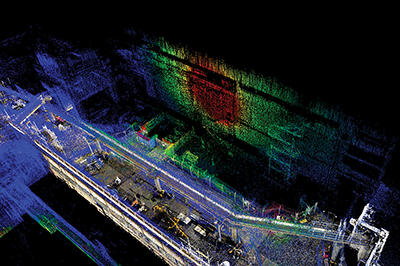 | ||
| The four-legged robots will carry out tasks such as mapping, data capture and characterisation |
They are able to provide remote inspection of hazardous or restricted areas, offer data collection using 3D scanning, share live-streamed information to any location and reduce the need for people to enter hazardous environments. This is safer, more flexible and more efficient.
Whilst Sellafield is exploring lots of different robotic technology, its four-legged friend, Spot, is its most high profile.
It is customised for nuclear site needs and offers radiation- resistant sensing systems and enhanced data collection payloads. Being highly mobile, Spot is capable of navigating staircases and rough terrain. It is sensor-rich, enabling 360° imaging, 3D light detection and ranging (LiDAR) scanning, gamma and alpha characterisation, swabbing, size reduction, photographic and video capture and environmental monitoring, and is enabled for secure, remote operations.
The benefits of Spot are huge. Safety is improved as fewer nuclear operators need to enter hazardous areas because the robots can be operated fully remotely.
Decommissioning can be accelerated and the work can be carried out faster as robots can work in these areas much longer than a human could and the amount of personal protective equipment (PPE) used and disposed of during inspections is reduced.
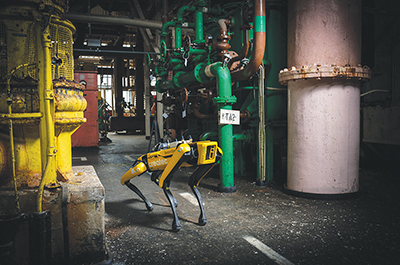 | ||
| Spot the dog trials in Calder Hall |
Experts can access high- quality, real-time data from anywhere, allowing quicker and more informed decisions with the robots able to carry out repeat inspections consistently.
The innovation aligns with the Nuclear Decommissioning Authority (NDA)’s ambitions to use robotics to transform decommissioning.
These developments have been made possible due to strong collaboration. This includes work with industry, research partners and the supply chain.
Key delivery partners include Boston Dynamics, developer of the original Spot robot, whose platform provides the mobility, endurance and stability needed to navigate the most challenging environments. Createc customised and deployed Spot for nuclear applications and supplies and maintains the robotic inspection platform. The company adapted Spot with advanced perception systems, imaging and radiation measurement technologies tailored to Sellafield’s needs and supported on-site trials, operator training and the safe introduction of Spot to active facilities. AtkinsRéalis provided technology and systems integration expertise to support the development of operational workflows, mission planning, digital integration and assurance processes.
RAICo includes the UK Atomic Energy Authority (UKAEA), NDA, Sellafield Ltd, the University of Manchester and AWE Nuclear Security Technologies. RAICo has enabled early trials, proof-of-concept demonstrations and testing in realistic environments. This allowed deployment to active areas. Their work helps bridge the gap between innovation and operational use.
Specialist Equipment Services, Sellafield Ltd is the team responsible for the equipment and the equipment deployments. This team of engineers has been at the forefront of deploying new and novel technology in first-of-a-kind situations both within Sellafield and across the Nuclear Decommissioning Authority estate. It is also developing the strategic thread coordinating the key delivery partners and ensuring a smooth transition from first-of-a-kinds into scalable deployments across the enterprise.
This collaboration is central to bringing advanced robotics into the day-to-day clean-up work.
Sellafield has been developing and deploying these robots for more than two years. A customised Boston Dynamics Spot robot has been used to inspect hard-to-reach areas and gather environmental and radiological data. This supports clean-up and decommissioning activities in challenging parts of the site.
The programme has achieved several milestones.
A three-day trial was carried out on the Sellafield site in 2021. This was supported by UKAEA’s Remote Applications in Challenging Environments (RACE) team. This work provided early evidence on how these robots can be safely deployed within nuclear facilities. It also highlighted their potential for future inspection tasks.
In 2022/23 , Sellafield identified the first suitable use cases for these robots on the Sellafield site and completed active demonstrations. These proved that Spot could navigate complex layouts, collect stable 3D scans and operate safely alongside existing plant and processes.
A customised Spot robot was then deployed for the first time in a C5 (highly radiological) area in 2023/24. The robot completed routine inspection routes and captured high-quality imagery and radiological data. This showed these robots can operate in areas traditionally accessible only to workers using full PPE with strict controls.
In partnership with AtkinsRéalis, Sellafield achieved an industry first in 2025 by remotely operating a customised Spot robot from outside the boundary of the nuclear licensed site. The operation was a live- streamed, secure teleoperation trial. It is claimed that this was the first time one of these robots has ever been controlled in this way in the UK nuclear sector and demonstrated the potential for future fully remote inspection operations.
Spot has successfully completed tasks including repeated inspection runs, environmental mapping and radiological characterisation. This progress forms the foundation for wider deployment of these robots, which is in line with the decommissioning strategy.
Sellafield Ltd will now move these robots from trial activity into routine, business-as-usual operations. The work will also support the development of a Nuclear Decommissioning Authority-wide roadmap for quadrupedal platforms. This will help other sites benefit from the technology.
The next steps include expanding the regular use of these robots across priority facilities and linking robotics data with 3D visualisation tools, digital twins and existing plant information systems for clearer, real-time situational awareness.
Working with partners, Sellafield aims to design and test new payloads and sensing packs to support a wider range of decommissioning tasks. These include radiological mapping, asset condition assessments and environmental characterisation.
While ensuring all robotic technologies meet the strict security requirements of the nuclear sector, over the next two years Sellafield will integrate these robots with more systems, tools and workflows. This will support faster, safer and more consistent decommissioning across the site. These steps will help move robotics from individual trials to a core part of its work.
www.sellafieldsites.com


